
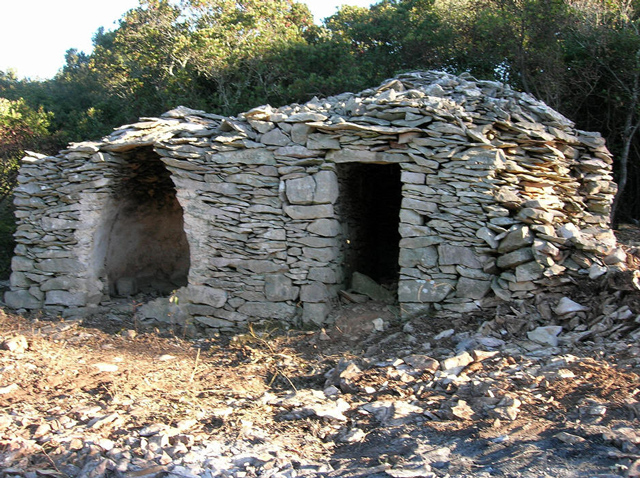
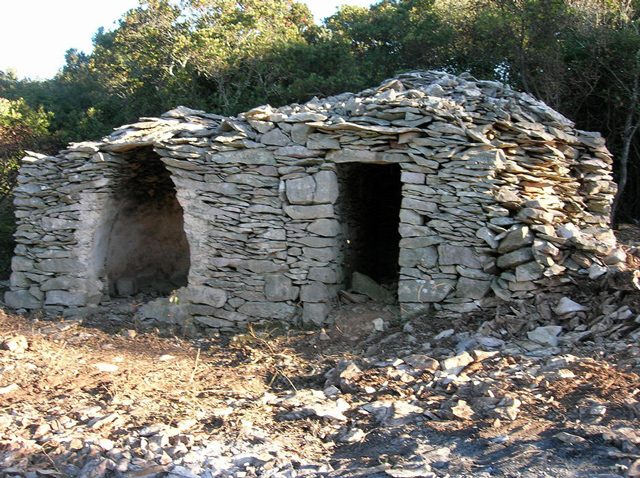
Vaulted Tanks (cuviers) and Huts (cabanes), two Distinct Buildings of the Nîmes Garrigue
Nous vous informons de la publication de notre dernier article dans la Revue L’Architecture vernaculaire, tome 50-51, CERAV
et disponible en ligne en suivant ce lien http://pierreseche.com/AV_2026-2027_Cagin.htm
Résumé de l’article:
CUVIERS ET CABANES, DEUX BÂTIS BIEN DISTINCTS DE LA GARRIGUE NIMOISE (Gard)
La pierre sèche agaraire a longtemps été une pratique absente des considérations savantes. Lorsqu’elle est, très rarement, mentionnée, c’est plutôt pour son pittoresque rural. Elle commence à être considérée vers la fin du XIXe siècle dans le cadre de l’archéologie. Elle est alors inscrite tout en bas des échelles de valeur technique liée au progrès et, de fait, associée aux sociétés « primitives ». En France, les cabanes en encorbellement, que cette technique permet de construire, sont ainsi associées aux gaulois.
Certains précurseurs vont casser ce mythe ; c’est le cas, dès les années 1920, de Paul Marcelin géologue, historien et naturaliste nîmois. Il travaille sur la garrigue et s’intéresse ainsi aux cabanes. Ses recherches sur les vocables de l’occitan ancien l’amènent à populariser le terme de capitelle pour les désigner.
Il est surtout l’un des premiers à faire le lien entre les caractéristiques des terrains géologiques et les aménagements agraires qu’il permettent de générer. Sa réflexion a pour effet d’ouvrir la voie d’une approche plus scientifique de l’analyse des paysages agraires et des bâtis qui les structurent. C’est cette approche, ces avancées et ses limites que nous analysons dans cet article. Une analyse qui passe par la nécessaire dimension lexicale des mots qui désignent ces patrimoines et qui sont rarement, pour leur part, exempts de présupposés et de biais, de quelques sortes qu’ils soient.
Vaulted Tanks (cuviers) and Huts (cabanes), two Distinct Buildings of the Nîmes Garrigue
For a long time, french dry-stone rural construction was absent from scholarly discourse. When it was mentioned—which happened very rarely—it was usually in the context of its rural, picturesque quality. Toward the end of the 19th century, it began to be considered within the field of archaeology. At that time, it was placed at the very bottom of the hierarchy of technical value—a hierarchy defined by the notion of progress—and was consequently associated with « primitive » societies. In France, for instance, the corbelled-stone huts created using this technique were attributed to the Gauls—a view that persisted until the 1970s, as Christian Lassure has developed in this very journal.
Few pioneers would go on to shatter this myth; one such figure, as early as the 1920s, was Paul Marcelin—a geologist, historian, and naturalist from Nîmes. His work on the ‘garrigue’ (scrubland) led him to take an interest in these small stone huts. Through his research into terms from the Old Occitan language, he introduced the word ‘capitelle’ to designate them.
Above all, he was one of the first to establish a link between the characteristics of geological terrain and the agricultural landscape features that such terrain can give rise to. His line of reasoning paved the way for a more scientific approach to analyzing agricultural landscapes and the structures that define them. In this article, we examine this approach, its contributions, and its limitations—an analysis that necessarily entails looking at the terminology used to describe these heritage landscapes, terms which are rarely free from underlying assumptions or biases of one kind or another.

